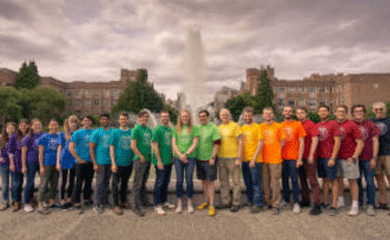
MolE PhD student Ted Cohen shares how molecular engineering has opened new opportunities for collaboration. Cohen is a 4th year molecular engineering Ph.D. student co-advised by Professor of Chemistry Daniel Gamelin and Professors of Materials Science & Engineering Christine Luscombe and Devin Mackenzie.
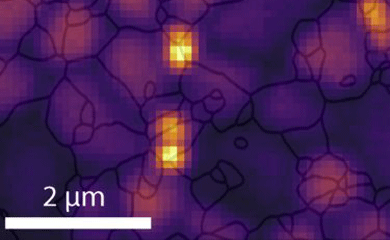
A team led by David Ginger, professor of chemistry and MolES faculty member, has developed a way to map strain in lead halide perovskite solar cells. Their approach shows that misorientation between microscopic perovskite crystals is the primary contributor to the buildup of strain within the solar cell, which creates small-scale defects in the grain structure, interrupts the transport of electrons within the solar cell, and ultimately leads to heat loss through a process known as non-radiative recombination.
Three teams led by University of Washington researchers have received competitive awards totaling more than $2.3 million from the U.S. Department of Energy Solar Energy Technologies Office for projects that will advance research and development in photovoltaic materials, which are an essential component of solar cells and impact the amount of sunlight that is converted into electricity. Two of the UW teams are led by MolES faculty members Scott Dunham, a professor of electrical and computer engineering and Hugh Hillhouse, a professor of chemical engineering.
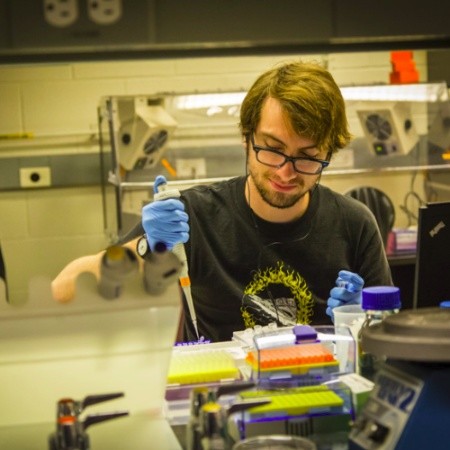
At the intersection of genetic engineering and nanoscience, second-year MolE PhD candidate Tyler (Ty) Jorgenson is developing a set of design rules for devices that join biology with solid-state materials. His research focuses on the self-assembly of solid-binding peptides and their interfaces with single-layer atomic (2D) materials, which he says is particularly promising for bioelectronic devices.
University of Washington researchers have developed a fast, inexpensive method to make electrodes for supercapacitors, with applications in electric cars, wireless telecommunications and high-powered lasers.
University of Washington scientists have built a new nanometer-sized laser "” using the thinnest semiconductor available today "” that is energy efficient, easy to build and compatible with existing electronics. The ultra-thin semiconductor is about 100,000 times thinner than a human hair.
About the Environmental Innovation Challenge
If you’ve got a passion for cleantech and the desire to make an impact, the UW Environmental Innovation Challenge is for you. In the EIC, interdisciplinary student teams define an environmental problem, design a solution, produce a prototype, and create a business summary that demonstrates market opportunity and the potential for impact. We define cleantech innovation as any product, process or service that reduces waste, minimizes energy consumption, and contributes to a healthier planet. Re-use/recycling, water usage, energy generation, green consumer products, nanotechnology – all are ripe for innovation. Read More
Please join the Clean Energy Institute as Professor Mildred Dresselhaus presents its inaugural interdisciplinary seminar:
Perspectives on Our Energy Future
Providing clean energy to the inhabitants of our planet is a major challenge to future generations. This talk will give my perspectives on this challenge in general terms and on how nanoscience and new nano-materials may contribute to addressing this challenge.
Thursday, November 7
4:00 PM 5:00 PM HUB Lyceum
Reception and drinks to follow
Presented by
Mildred Dresselhaus, PhD
Professor of Physics and Electrical Engineering, Emerita
Massachusetts Institute of Technology
Professor Mildred Dresselhaus is currently one of twenty-three Institute Professors at the Massachusetts Institute of Technology, with appointments in the Department of Electrical Engineering and Computer Science and the Department of Physics. Read More
The UW Clean Energy Institute (CEI) announces two new graduate fellowship opportunities. The mission of the CEI Fellowship program is to catalyze clean energy research that is related to solar energy conversion (Sun-to-Electricity and Sun-to-Chemicals), electrical energy storage (Electricity-to-Chemicals/Materials/Other), and electrical systems and the grid (Electricity Distribution).
Some specific goals of the program are to:
1. Seed new exploratory research activity that addresses the core CEI mission areas
2. Attract the best new graduate students to work at UW on projects in core CEI mission areas
3. Read More
From UW Today: September 11, 2013
UW engineers get grant to make cookstoves 10 times cleaner for developing world
Nearly 500 million households roughly 3 billion people, or 42 percent of the world's population rely on burning materials such as wood, animal dung or coal in stoves for cooking and heating their homes. Often these stoves are crudely designed, and poor ventilation and damp wood can create a smoky, hazardous indoor environment day after day.
A recent study published in The Lancet estimates that 3.5 million people die each year as a result of indoor air pollution from open fires or rudimentary stoves in their homes. Read More